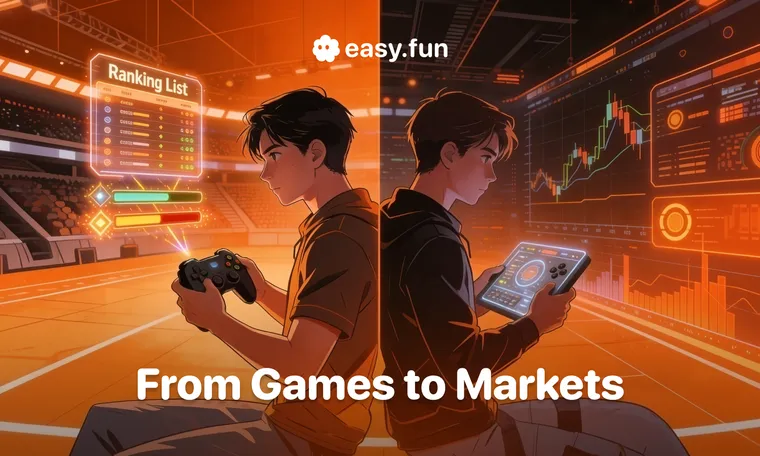
For years, we were told that trading was about prediction. Charts, indicators, macro takes — all pointing toward a single moment where you "make the call". But that story never quite resonated with a generation that grew up inside games, live streams, and real-time multiplayer worlds.
Gen Z and Gen Alpha didn't learn skills through textbooks or lectures. They learned through arenas. Through repetition, feedback loops, leaderboards, and constant iteration under pressure. In games, you don't watch others play and hope to win by osmosis. You queue up, you lose, you adjust, and you go again.
And quietly, almost inevitably, that mindset is spilling into trading.
What we're seeing isn't just younger users entering markets earlier. It's a deeper cultural shift: from spectatorship to participation, from passive following to active engagement, from "guessing right" to "getting better". Trading, for this generation, isn't a side bet on the future. It's a skill-based competitive activity — one that looks far more like gaming than gambling.
The Old Trading Stack Was Built for Observers, Not Players
The modern trading ecosystem still assumes that most users want to watch, not act.
Centralized exchanges optimize for liquidity and throughput, but their interfaces treat users as isolated decision-makers. You trade alone, you win or lose alone, and improvement is something you're expected to figure out on your own. Social features, when they exist, are usually bolted on — follower counts, signal sharing, influencer dashboards — all reinforcing a top-down dynamic.
Decentralized trading promised self-custody and composability, but culturally, it inherited the same problem. DEXs made markets permissionless, not participatory. Most users still hover on the sidelines, copying wallets or reacting to screenshots, rather than developing intuition through direct experience.
At the same time, a creator-led trading culture created a different distortion. Attention aggregated around a small number of personalities. Audiences learned to consume takes, rather than build skills. Engagement became parasitic: views, likes, and comments flowed upward, while the majority stayed passive.
For a generation raised on interactive systems, this is deeply misaligned. Gamers don't want heroes to worship — they want ladders to climb. They don't want alpha drops — they want feedback. And they don't want to be told who's good — they want to know why, and whether they themselves are getting better.
The result is a gap. Young users are entering markets with the wrong tools, the wrong incentives, and the wrong mental models. Trading feels either intimidating or performative — rarely empowering.
Trading Isn't Missing Education — It's Missing a Frame
We don't believe the solution is more content, more indicators, or louder influencers.
What's missing is a competitive frame.
In games, improvement is obvious because the system is designed to surface it. You see your rank move. You feel pressure. You understand why you lost. The environment itself teaches you. That's not accidental — it's deliberate market design.
At easy.fun, we start from a simple belief:
Trading is a skill, and skills emerge through participation, not observation.
Instead of asking users to predict markets in isolation, we focus on putting them into action. Instead of optimizing for follower counts, we optimize for engagement loops. Instead of rewarding attention, we reward behavior.
This is where Gen Z and Alpha intuitively click. They don't separate "learning" from "playing". They expect systems to respond to them in real time. They expect feedback, comparison, and progression. When those elements are present, participation becomes natural.
easy.fun is built around this idea. We're not trying to turn trading into a game by adding gimmicks. We're recognizing that markets are already competitive — they just haven't been structured like one.
By introducing visible participation, shared contexts, and outcome-driven feedback, we turn passive followers into active players. Users don't just watch trades happen — they take part, measure themselves, and improve through repetition.
The goal isn't to make trading easier. It's to make improvement visible.
From Solo Execution to Shared Arenas
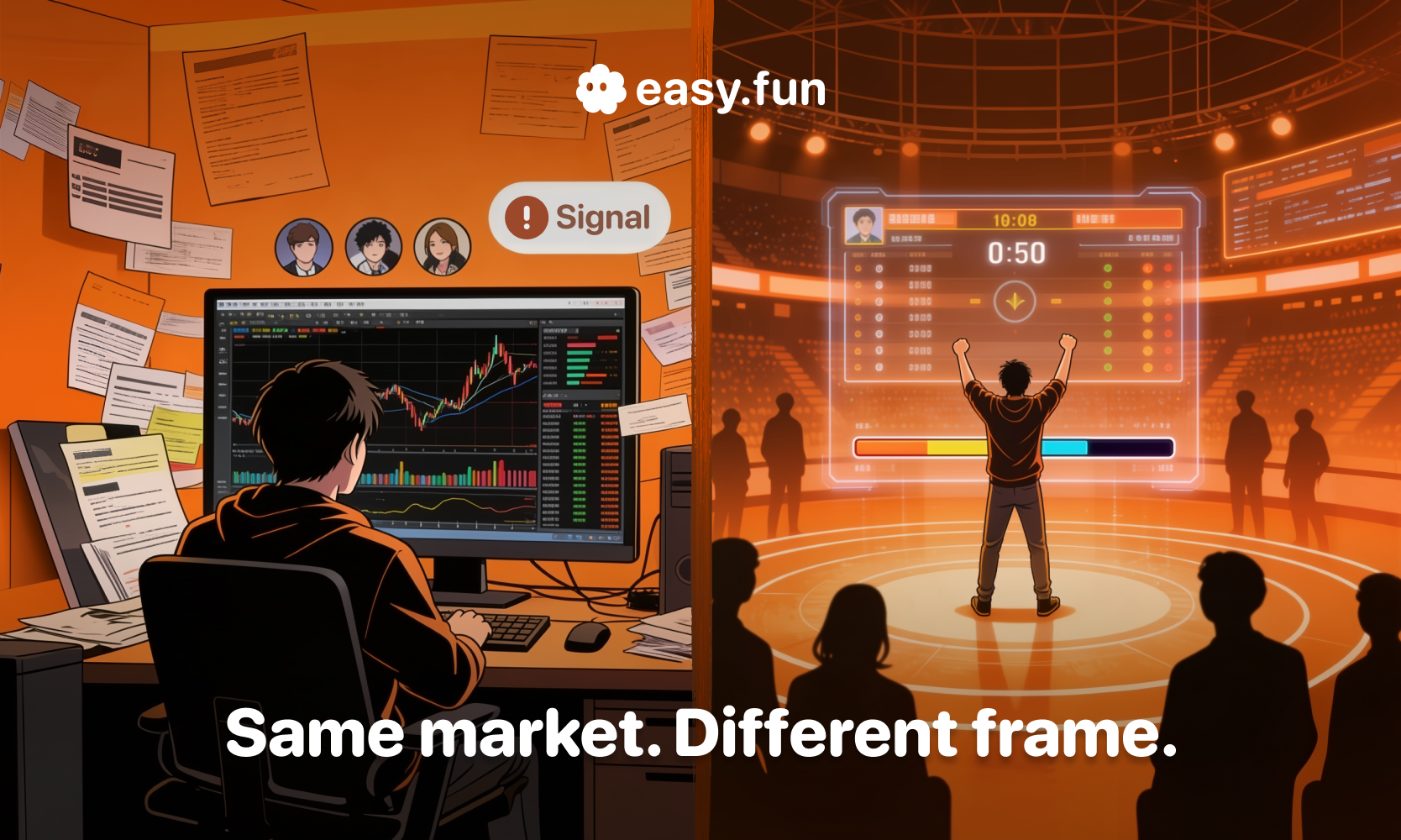
At the core of easy.fun is a shift from isolated execution to shared market experience.
Instead of treating each trade as a private event, we frame trading as something that happens in public contexts — environments where actions are comparable, outcomes are legible, and progress is tracked over time.
Users interact with live market conditions while seeing how others respond to the same inputs. This alone changes behavior. When decisions exist within a shared frame, people think differently. They become more intentional, more reflective, and more adaptive.
Participation is structured through mechanisms that feel familiar to anyone who's spent time in competitive systems:
- Clear entry points
- Repeatable sessions
- Performance feedback
- Relative comparison
You don't need to follow a "top trader" to learn. You learn by doing, alongside others, under the same constraints.
We've seen users who previously only consumed trading content begin to place small, deliberate trades — not chasing outcomes, but testing hypotheses. Over time, patterns emerge. Risk management improves. Emotional reactions soften. Not because someone told them what to do, but because the system made learning unavoidable.
Visual tools reinforce this process. Performance summaries emphasize consistency over single wins. Comparative views show how decisions stack up against peers. The focus isn't on who made the most, but on how they traded.
We're also building toward more explicit competitive structures — shared arenas where participation itself becomes the point. These systems are designed to surface skill naturally, without turning markets into spectacles. Details matter here, and we're taking our time. What matters is the direction: markets as environments for growth, not performance stages.
For Gen Z and Alpha, this feels obvious. It mirrors how they learned everything else.
Markets as Cultural Spaces, Not Just Financial Ones
Long term, we see easy.fun as more than a trading app.
We see it as an ecosystem where market participation becomes a social primitive — a place where people gather not to watch prices, but to test themselves against them. Where improvement is communal. Where skill is respected because it's earned in public.
As competitive structures mature, entirely new roles emerge: not influencers, but participants with track records. Not audiences, but communities shaped by shared experience. Markets stop being abstract forces and start feeling like places you inhabit.
This is especially powerful for younger generations. When markets feel legible and participatory, they stop being intimidating. Trading becomes less about prediction and more about process. Less about luck, more about mastery.
We're building toward that future carefully, deliberately, and in public. The arena is opening — and the culture around trading is changing with it.
Enter the arena!
- Explore easy.fun - Experience trading as participation, not prediction.
- Join our Discord - Meet traders who are learning in public.
- Follow us on X - Stay close as we continue building.