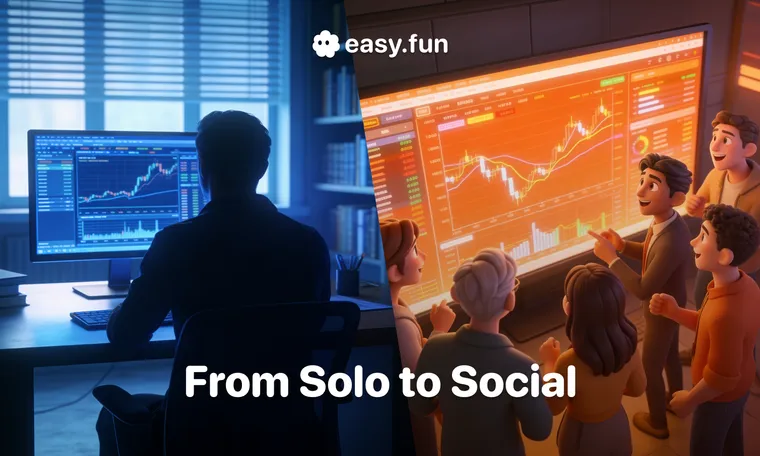
Trading has always been framed as a solitary act. One screen. One account. One set of decisions made in silence.
Yet if you look at how people actually learn, improve, and stay engaged—whether in games, sports, or creative work—progress almost never happens alone. It happens in shared spaces. Through comparison, feedback, rivalry, and momentum.
Web3 trading today feels strangely behind. We have real-time blockchains, transparent execution, and global liquidity—yet the experience itself still isolates traders from one another. Strategies live on Twitter threads. Performance is debated in Discord. Execution happens somewhere else entirely.
We believe that gap matters. Because trading isn't just about placing orders. It's about learning under pressure, reacting in context, and measuring yourself against others who are playing the same game, at the same moment. That's why we believe the future of trading isn't solo—it's social, competitive, and arena-shaped.
Why Trading Still Feels Like a Lonely Sport
Modern trading platforms are efficient, but emotionally flat.
Centralized exchanges optimized for speed and liquidity, not learning. You execute trades, watch PnL fluctuate, and leave. There's no sense of shared context—no awareness of how others are positioned, reacting, or adapting in real time. Every trader is isolated, even when millions are active on the same market.
On the other end, social platforms fragment the experience. Twitter shows narratives after the fact. Discord hosts discussion without execution. YouTube explains trades that already happened. None of these environments connect action, outcome, and community feedback in the same moment.
The result is a strange contradiction: trading is globally networked, but experientially alone.
This isolation hurts beginners, who lack reference points. It hurts skilled traders, whose insights can't compound socially. And it hurts the ecosystem, because trust is built on visibility—and most performance remains unverifiable, contextless, or selectively shared.
Without a shared arena, trading becomes guesswork performed in private, then justified in public. That's not how skills develop. And it's not how communities form.
Trading Becomes Social When Context Is Shared
We don't think trading needs more noise. It needs shared reality.
At easy.fun, our core belief is simple: when traders see the same data, act in the same moment, and measure outcomes side by side, trading naturally becomes social.
We didn't borrow this idea from finance—we borrowed it from everywhere else that produces skill. Competitive games. Sports leagues. Creative platforms. None of them rely on isolated practice alone. They rely on arenas.
An arena isn't just a leaderboard. It's a structured environment where participation is visible, outcomes are verifiable, and improvement happens through comparison—not imitation.
That's why easy.fun is built around real-time, onchain context powered by Hyperliquid. Trades aren't screenshots. Performance isn't narrative. It's data, visible as it happens, shared across the same market conditions.
This shifts behavior immediately. Following a trader becomes participation, not fandom. Observing turns into learning. Posting results becomes unnecessary because the system already reflects them.
Most importantly, traders stop feeling like they're playing alone. They're reacting to the same volatility, the same liquidity, the same momentum—together.
That's when trading stops being solitary execution and starts becoming a social discipline.
How Arena-Style Trading Actually Works
Arena-style trading doesn't require gamification. It requires alignment.
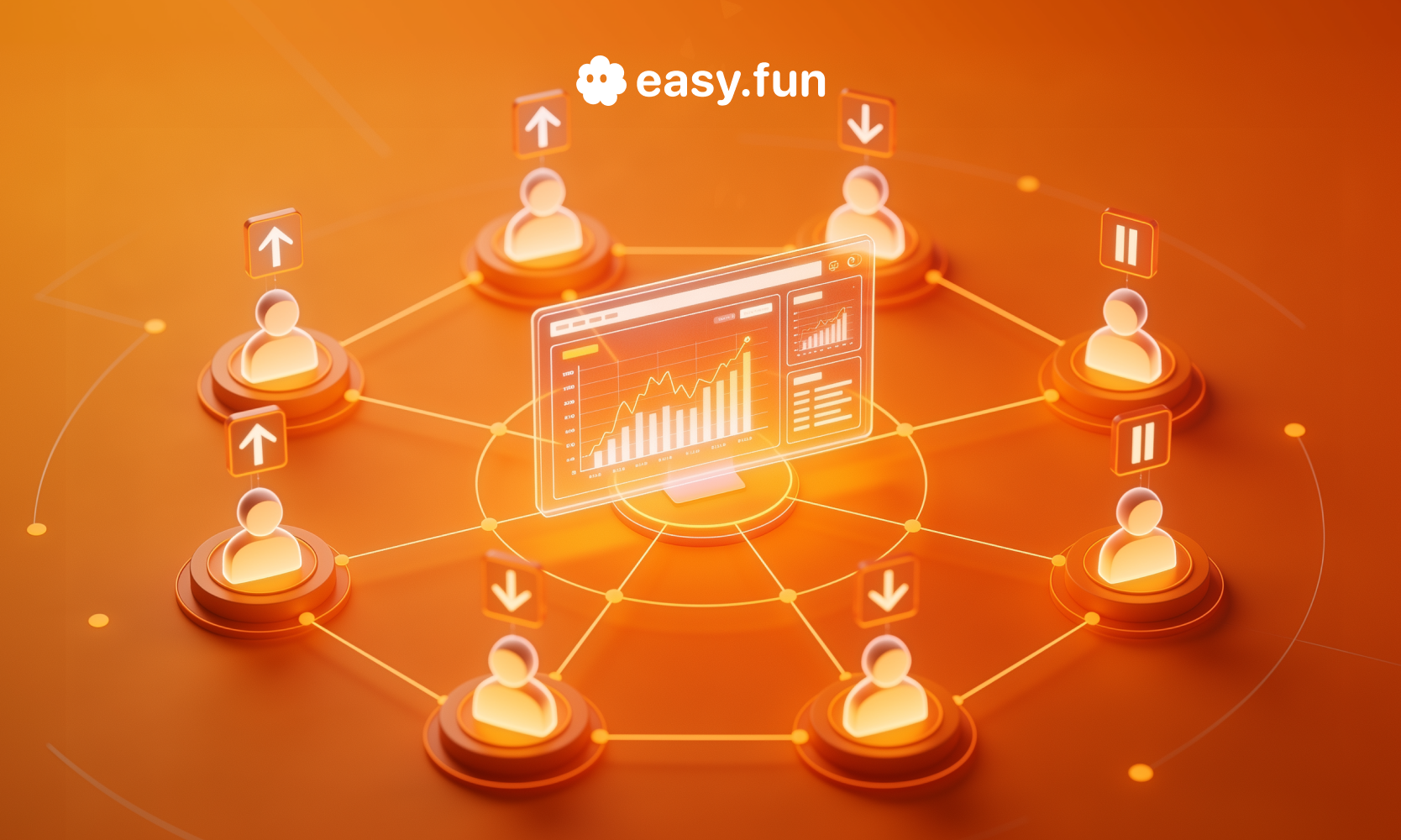
On easy.fun, alignment starts with shared data. Hyperliquid provides real-time, onchain execution data—positions, fills, PnL—without delay or interpretation. Everyone sees the same reality, at the same time.
From there, social dynamics emerge naturally.
A trader opens a position. Others see it live. Some follow. Some fade. Some simply observe. What matters is that all actions are anchored to verifiable context. There's no lag between decision and visibility.
This creates a feedback loop that traditional platforms lack. Traders learn not from summaries, but from sequences: entry timing, sizing, reaction to drawdown, exit discipline. The "how" becomes as visible as the "what".
Over time, communities form around styles rather than personalities. Aggressive scalpers. Patient swing traders. High-conviction directional players. The arena doesn't promote one approach—it lets performance speak under shared conditions.
This is where participation replaces passive consumption.
Instead of reading threads about strategy, users experience it unfolding. Instead of copying blindly, they understand why a trade worked—or didn't—because the context is preserved.
Even without explicit tournaments live today, the competitive frame already exists. Traders benchmark themselves mentally. They track consistency. They compare decision-making under pressure. The arena makes these comparisons implicit and continuous.
That's how learning compounds—not through instruction, but through exposure and repetition inside a shared environment.
A New Cycle Needs a New Default
Every cycle resets more than prices. It resets behavior.
New participants arrive. Old assumptions get tested. And traders—whether they realize it or not—start looking for better ways to survive volatility, learn faster, and stay sane doing it.
A new year creates the same opening. Not just to change strategies, but to rethink the structure around trading itself.
For too long, the default has been isolation. One wallet. One screen. One set of decisions made in silence. Even when trading became more accessible, it didn't become more social in any meaningful way. You could follow others—but you couldn't really trade with them.
We don't think that's how a real skill evolves.
Our long-term vision for easy.fun is simple: make trading a shared experience without turning it into noise. An arena where individual performance still matters—but context is collective. Where traders don't just react to the market, but measure themselves against peers, learn in public, and grow through structured competition.
This isn't about copying trades or chasing signals. It's about the environment. About showing up every day knowing you’re not alone—others are facing the same conditions, the same pressure, the same decisions in real time.
As easy.fun evolves, we're building toward formats that make this explicit: more visible benchmarks, clearer progression, and competitive structures that reward consistency and skill—not hype. Some of these layers are already here. Others are coming into view.
In the next phase of onchain trading, the edge won't come from secrecy. It will come from clarity, community, and the courage to trade in the open.
If trading is something you want to take seriously this year, the question isn't just what you trade.
It's who you trade alongside.
Enter the arena!
- Explore easy.fun - Discover the arena and experience trading in real time.
- Join our Discord - Meet traders who learn and compete together.
- Follow us on X - Stay close as the arena continues to evolve.