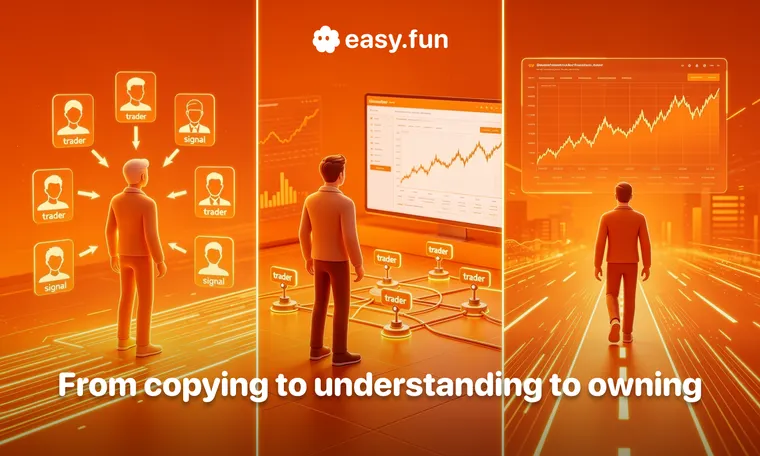
Most beginners don't start trading by building strategies.
They start by copying.
They follow someone on Twitter. They join a Discord. They subscribe to signals. At first, it feels like a shortcut—skip the learning curve, mirror someone experienced, and capture the same outcomes.
Sometimes it even works. For a while.
But then something breaks. A trade goes wrong. The leader changes behavior. The market shifts. And suddenly, copying without understanding becomes indistinguishable from guessing.
This is the hidden limitation of traditional copy trading. It gives access to decisions, but not to reasoning. It produces outcomes, but not learning.
We think copy trading shouldn't be the end state.
It should be the bridge.
Why Copy Trading Often Fails Beginners
Copying Without Context
Most copy trading systems are built around execution replication.
You select a trader. You mirror their positions. Your account follows their actions automatically. The assumption is simple: if they win, you win.
But in practice, the gap between action and understanding remains.
- You don't know why a position was opened
- You don't understand the risk behind it
- You can't adapt when conditions change
This leads to fragile learning.
When results are good, confidence increases—but without foundation. When results turn negative, there's no framework to interpret what went wrong.
Dependency Instead of Development
Another issue is psychology.
Copy trading can create dependency. Beginners rely on external decision-makers rather than developing internal frameworks. Over time, this slows progress.
Instead of asking "What is the market doing?"
They ask "What is this trader doing?"
This shift may improve short-term outcomes, but it delays long-term growth.
Lack of Real-Time Transparency
Even in crypto-native platforms, many copy trading systems rely on partial visibility.
Followers see trades after they happen, or without full context of exposure, timing, and risk. This makes it difficult to learn from the process itself.
Without real-time, verifiable data, copy trading becomes reactive rather than educational.
Copy Trading as a Learning System
From Replication to Observation
We believe copy trading should not be about blind replication.
It should be about structured observation.
Hyperliquid enables real-time, onchain execution visibility. easy.fun builds on top of this to turn copy trading into a transparent, shared environment where strategies are not just followed—they are observed as they unfold.
This changes the experience fundamentally.
Instead of copying a trade after the fact, users see:
- when positions are initiated
- how they evolve under market pressure
- how risk is managed across time
The focus shifts from "what" to "how".
Reducing the Gap Between Seeing and Doing
Traditional learning requires abstraction.
You study charts, read explanations, and try to apply concepts later.
Arena-based copy trading compresses this loop.
You observe decisions in real time, within the same market conditions you're participating in. The gap between observation and action becomes smaller.
Over time, users begin to internalize patterns:
- how experienced traders size positions
- how they react to volatility
- how they exit under uncertainty
This is how passive followers become active participants.
Copy Trading as a Transitional Layer
In our view, the ideal outcome of copy trading is not permanent reliance.
It is independence.
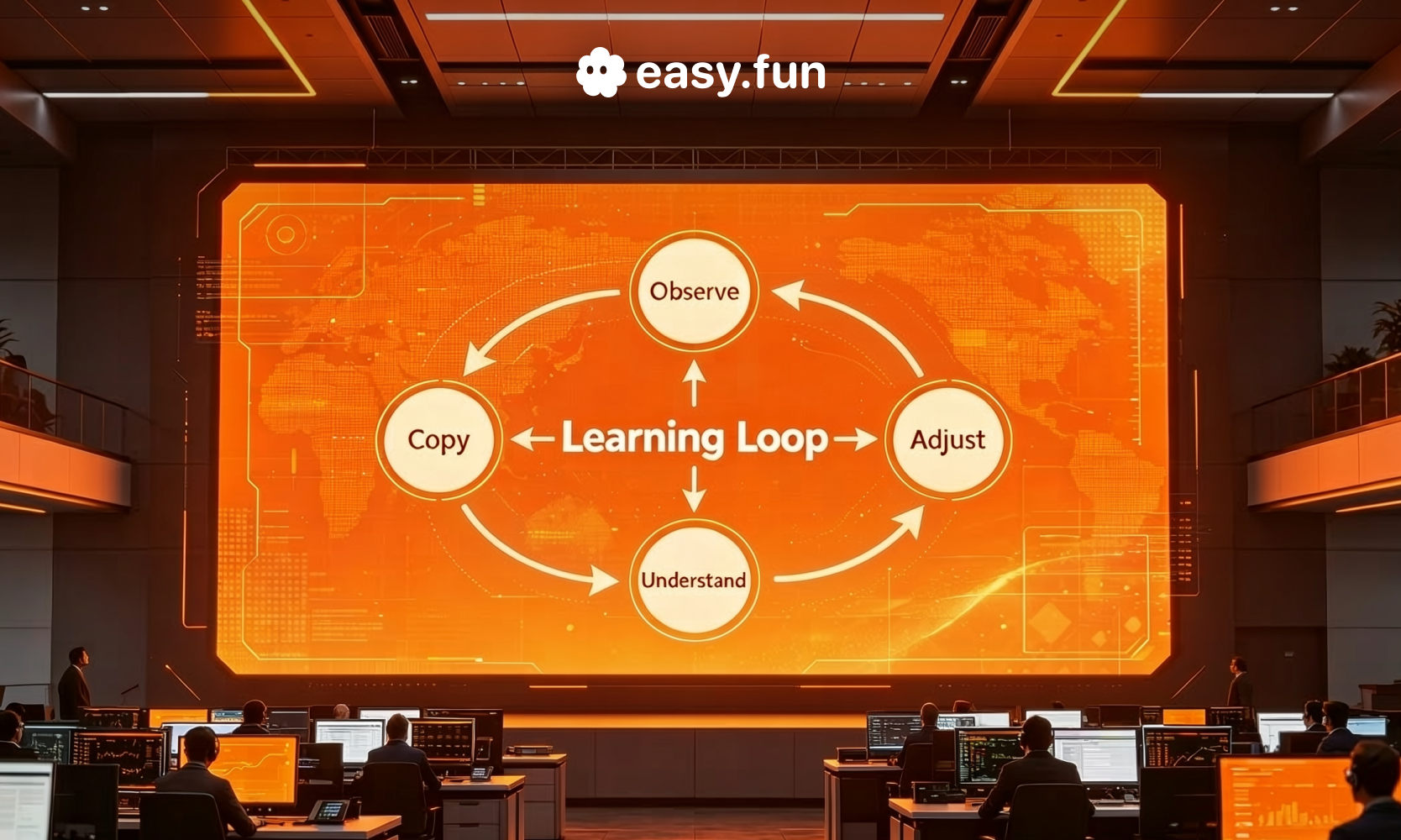
Users should move through stages:
- Copying actions
- Understanding patterns
- Adapting behavior
- Forming their own strategy
The arena environment accelerates this progression.
Because behavior is visible and comparable, learning becomes continuous—not episodic.
How Arena-Based Copy Trading Works
Real-Time Strategy Visibility
On easy.fun, copy trading is not delayed.
Users observe trades as they happen. This includes entry timing, position size, and how exposure changes over time.
This matters because timing and context define strategy quality.
Seeing a profitable trade after the fact provides limited value.
Seeing it unfold provides insight.
Contextual Learning Instead of Isolated Signals
Each trade exists within a broader environment.
Market structure, volatility, liquidity conditions—all influence decisions. By presenting trades within shared context, easy.fun allows users to understand not just the action, but the conditions behind it.
This transforms copy trading into a contextual learning system.
Behavioral Pattern Recognition
Over time, users begin to recognize patterns.
- consistent sizing vs erratic exposure
- structured exits vs emotional reactions
- adaptive strategies vs rigid ones
These patterns are difficult to teach abstractly.
But easy to observe in a live environment.
Gradual Participation Shift
A typical user journey looks like this:
Stage 1 — Passive Copying
Users mirror trades without a deep understanding.
Stage 2 — Observational Learning
Users start noticing patterns and differences.
Stage 3 — Selective Execution
Users choose when to follow and when to deviate.
Stage 4 — Independent Strategy
Users develop their own framework.
The goal is not to eliminate copying. It is to make it productive.
Case: From Follower to Trader
A beginner joins easy.fun and starts copying a top trader.
Initially, he focuses on outcomes.
Over time, he noticed:
- the trader rarely over-allocates
- entries are patient, not reactive
- exits follow structure even during volatility
The user begins adjusting his own behavior.
He reduces position size.
He waits for confirmation.
He manages risk more carefully.
Eventually, he stops copying every trade.
He starts making decisions.
This is the transition we aim to enable.
Toward Structured Competitive Learning
As transparency improves, copy trading naturally evolves into comparison.
Users begin to evaluate multiple strategies simultaneously. They understand differences in approach, not just results.
This creates a more dynamic learning environment—one that begins to resemble competitive systems, where performance is visible and measurable across participants.
Over time, this will become even more structured.
From Following to Competing
Copy trading is not the final form of participation.
It is the entry point.
As users develop skill and confidence, they move toward active participation. They stop following individual traders and start engaging with the market directly.
At scale, this creates a different ecosystem.
Instead of a small number of signal providers and a large number of followers, you get a spectrum of participants:
- beginners learning through observation
- intermediate traders refining behavior
- advanced traders demonstrating consistency
This naturally leads toward more structured forms of interaction.
Not forced gamification, but emergent competition—where strategies are visible, comparable, and evolving in real time.
easy.fun is building toward that environment.
An arena where copying is not a dependency, but discovery.
Start by following.
Stay to understand.
Copy trading shouldn't keep you where you are. It should move you forward.
- Explore easy.fun - Experience copy trading as a real-time learning system.
- Join our Discord - Learn alongside traders at different stages.
- Follow us on X - Stay updated as the arena evolves.