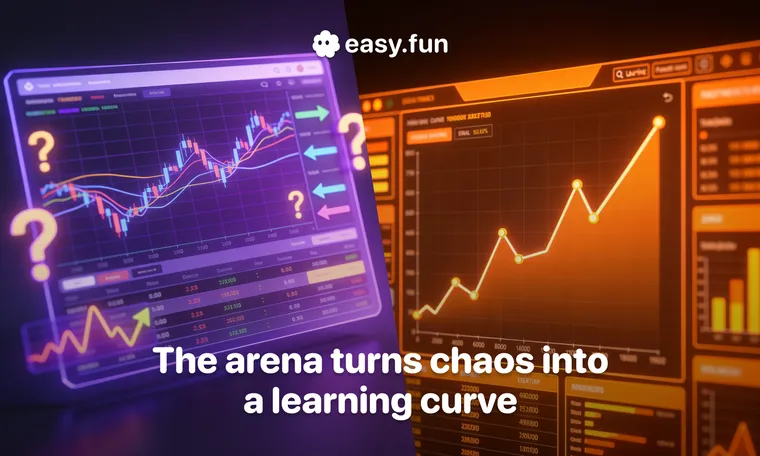
Almost every trader remembers their first few months in the market.
The excitement of discovering charts. The adrenaline of opening a position. The belief that with enough information—enough Twitter threads, enough YouTube explanations, enough indicators—winning consistently should eventually become simple.
Then reality arrives.
Prices move faster than expected. Positions feel larger than intended. A trade that looked obvious in hindsight becomes confusing in real time. Emotional reactions begin to shape decisions: fear of missing out, hesitation during exits, revenge trading after losses.
The surprising part is that these mistakes aren't unique. They're structural. Nearly every beginner makes the same handful of errors, regardless of market or cycle. The difference between traders who improve and those who quit is rarely intelligence—it's environment.
That's why we believe the next evolution of trading platforms isn't just better execution. It's better structure. When trading happens inside an arena rather than in isolation, many of these mistakes become easier to recognize—and easier to avoid.
Why Beginners Repeat the Same Mistakes
The Learning Environment Is Broken
Most trading platforms assume users already know how to trade.
Interfaces are designed for execution speed, not learning clarity. Risk tools exist but remain secondary. Data is abundant but rarely contextualized. As a result, beginners enter markets with powerful infrastructure but little guidance about how to behave inside it.
Without structure, traders rely on instinct and external narratives.
They follow signals. They chase momentum. They react to social sentiment rather than observing market structure. Each mistake reinforces the next.
Emotional Feedback Loops
Trading is uniquely emotional because it combines uncertainty with financial consequence.
Beginners often experience a sequence like this:
- A successful early trade builds confidence.
- Position sizes grow quickly.
- A sudden loss triggers panic.
- Emotional trades follow.
This loop repeats until discipline replaces reaction—or the trader exits the market entirely.
Noise Overwhelms Signal
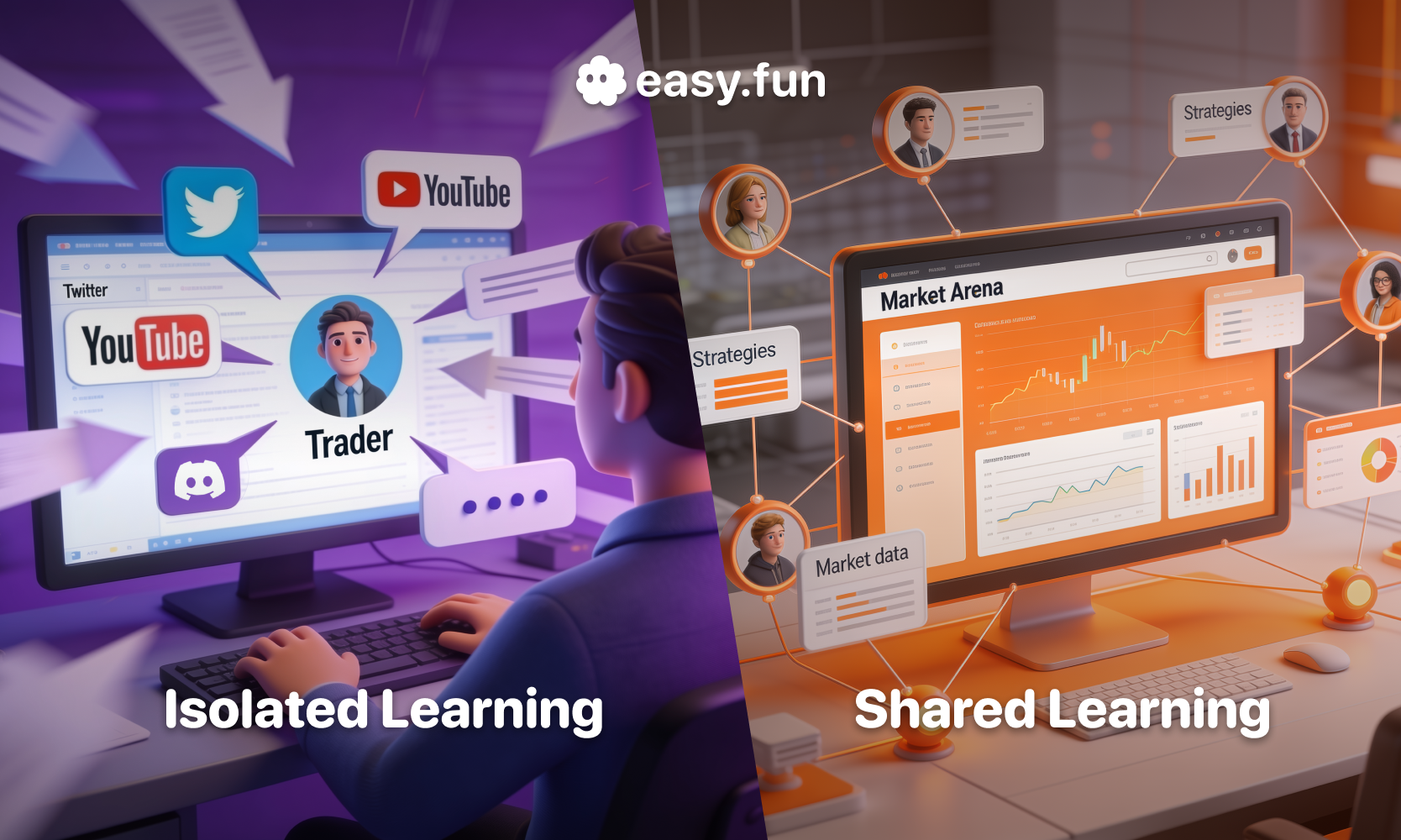
Modern trading culture amplifies noise. Social platforms reward bold predictions and dramatic outcomes. Beginners are exposed to thousands of opinions but very little observable process.
Without shared context, it's hard to tell whether a strategy works—or simply looked convincing after the fact.
This is why most beginners struggle not because markets are impossible, but because the environment makes learning inefficient.
Why Arena Trading Changes the Learning Curve
Structure Reduces Chaos
We built easy.fun around a simple idea: trading becomes easier to understand when it happens in a shared environment.
In an arena, decisions occur within visible context. Traders see how strategies unfold in real time, not just the outcomes posted afterward. This transparency transforms trading from an isolated activity into a collective learning environment.
Instead of guessing how others approach risk, timing, and position management, users observe these patterns directly.
Participation Replaces Passive Consumption
Most beginners start as spectators.
They watch charts, scroll social feeds, and absorb opinions without clear frameworks for action. The arena model shortens the distance between watching and participating.
When traders can observe behavior under real market conditions, intuition develops faster. Patterns become recognizable. Mistakes become identifiable.
Competition Encourages Discipline
Competition often improves performance—not because traders try harder, but because structure changes behavior.
When performance exists within shared benchmarks, impulsive strategies quickly reveal their weaknesses. Consistent habits become visible advantages.
The arena doesn't reward loud predictions. It rewards sustainable decision-making.
This shift—from isolated speculation to observable competition—creates an environment where beginners can improve through exposure rather than guesswork.
The 5 Beginner Mistakes and How the Arena Helps Fix Them
Emotional Trading
The Mistake
Beginners often react emotionally to market movement. Rapid price changes trigger impulsive decisions—entering too late, exiting too early, or doubling down on losing trades.
Why It Happens
Without reference points, traders interpret every movement as a signal.
How the Arena Helps
In a shared environment, traders see how experienced participants behave during volatility. Instead of reacting immediately, they observe how others manage exposure and timing.
Seeing disciplined behavior in context naturally encourages calmer decision-making.
Poor Risk Management
The Mistake
New traders frequently risk too much on single positions. A few incorrect trades can wipe out weeks of progress.
Why It Happens
Position sizing is rarely emphasized in beginner education.
How the Arena Helps
When risk behavior becomes visible—through allocation patterns and consistent exposure—discipline stands out. Traders begin to recognize that longevity often matters more than aggressive gains.
Over time, this visibility encourages better risk frameworks.
Chasing Momentum
The Mistake
Entering trades after large price moves because the opportunity feels obvious.
Why It Happens
Momentum feels convincing in hindsight.
How the Arena Helps
Watching trades unfold live shows the difference between early positioning and late reactions. This teaches timing more effectively than retrospective analysis.
Overconsumption of Social Noise
The Mistake
Following too many opinions and signals from social media.
Why It Happens
Information abundance creates false confidence.
How the Arena Helps
In the arena, actions matter more than opinions. Traders evaluate strategies based on observable execution rather than persuasive narratives.
This shifts attention from commentary to behavior.
Lack of Consistency
The Mistake
Beginners frequently switch strategies after losses.
Why It Happens
Without measurable feedback, it's hard to distinguish strategy flaws from random outcomes.
How the Arena Helps
Session-based performance visibility reveals patterns over time. Traders learn that consistency—not constant reinvention—is the real edge.
As structured competitive layers continue to develop within the ecosystem, these patterns will become even clearer, encouraging disciplined participation rather than impulsive experimentation.
From Beginner Mistakes to Structured Mastery
The long-term goal of easy.fun is not simply to reduce beginner mistakes.
It is to build an environment where skill naturally emerges through participation.
When trading becomes transparent, comparable, and competitive, improvement becomes easier to track. Traders begin to measure themselves against consistent benchmarks rather than isolated outcomes.
Over time, this changes culture.
Instead of chasing viral trades, traders focus on sustainable performance. Communities form around disciplined strategies. New participants learn faster because the process of decision-making becomes visible.
As the arena continues to evolve, new formats will further clarify these dynamics—introducing structured ways to compare strategies, measure consistency, and reward long-term skill.
Markets will always contain uncertainty.
But the environment surrounding them can make learning far more efficient.
That's the direction we're building toward.
Every trader starts as a beginner. The difference is whether the environment helps them improve.
The arena is open!
- Explore easy.fun - Discover the arena and experience trading in a shared environment.
- Join our Discord - Learn alongside traders refining their approach.
- Follow us on X - Stay updated as the arena continues to evolve.