
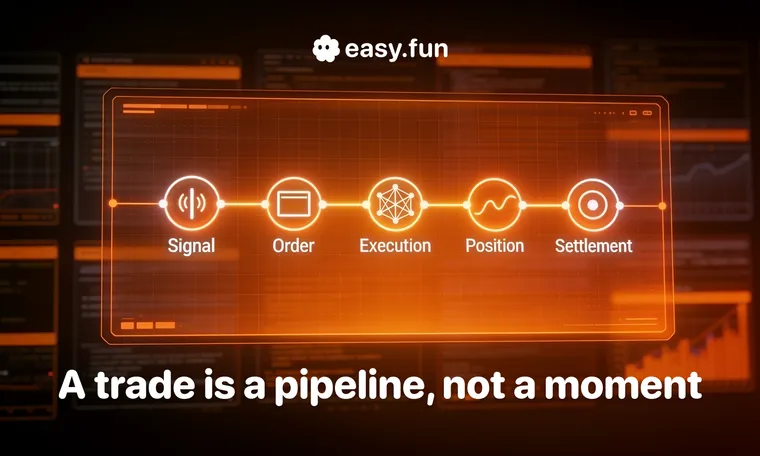
Every trade feels simple on the surface.
You see a price. You decide. You click. A position appears. Seconds later, it's in profit or loss. From the outside, trading looks like a sequence of quick decisions and immediate outcomes.
But underneath that moment is a system.
Orders need to be matched. Positions need to be recorded. Risk needs to be calculated. Settlement needs to be finalized. And all of this happens not in isolation, but within a constantly shifting environment of liquidity, volatility, and competing participants.
In traditional markets, this process is hidden. Execution is opaque, settlement is delayed, and most traders never see what actually happens between decision and outcome.
Onchain trading changes that.
And when paired with a real-time environment like easy.fun, it doesn't just make execution faster—it makes it visible.
The Hidden Complexity of Trade Execution
Why Most Traders Don't Understand What Actually Happens
In most trading environments, execution is treated as a black box.
You place an order, and the system returns a result. Whether the order was filled instantly, partially matched, or routed through multiple layers of liquidity is rarely visible. Settlement processes remain abstract. Risk calculations happen in the background.
This lack of transparency creates several issues.
First, traders struggle to understand why outcomes differ. Slippage, latency, and execution quality are experienced but not fully explained.
Second, trust becomes indirect. Users rely on platform credibility rather than verifiable data. Even in centralized systems with high performance, the internal mechanics remain opaque.
Third, learning is limited. Without visibility into execution, traders can improve strategy, but not their understanding of how trades interact with the market itself.
Fragmentation Between Decision and Outcome
There is also a structural gap between signal and settlement.
Signals come from charts, narratives, or intuition. Execution happens through an interface. Settlement occurs somewhere deeper in the system. These layers are disconnected.
For beginners, this creates confusion. For advanced traders, it creates inefficiency.
Markets move in real time. But the understanding of how trades actually move through the system often does not.
Making Execution Legible Changes Behavior
Transparency Is Not a Feature — It's a Shift in Mental Model
We believe trading improves when the full lifecycle of a trade becomes legible.
Not just the decision. Not just the result.But the path in between.
Hyperliquid provides a foundation for this shift. By operating as a high-performance onchain trading system, it ensures that execution, position updates, and settlement occur on a shared, verifiable layer.
easy.fun builds on top of this by translating that system into something traders can actually perceive in real time.
Instead of treating execution as an invisible backend process, we surface it as part of the trading experience.
This has two effects.
First, it reduces ambiguity. Traders see how their actions translate into positions under real market conditions.
Second, it aligns participation. When execution is visible and shared, traders are no longer acting in isolation. They're interacting with a common system that everyone can observe.
From Clicks to Systems Thinking
Most platforms optimize for clicks.
We optimize for understanding.
When traders can see how orders move through the system—how liquidity affects fills, how positions update, how risk evolves—they begin to think differently.
They move from reactive behavior to structured decision-making.
They stop asking "Did I win this trade?"
And start asking, "What actually happened?"
That shift is subtle, but it's what separates casual participation from real skill development.
From Signal to Settlement in Real Time
Signal: Decision Formation
Every trade starts with a signal.
This signal can come from price action, technical structure, macro context, or simply pattern recognition. What matters is that it exists before execution.
In easy.fun, signals are not isolated thoughts—they exist within a shared environment. Traders observe market conditions alongside others, seeing how volatility, liquidity, and positioning evolve in real time.
This creates context before action.
Order Placement: Translating Intent into Action
Once a decision is made, it becomes an order.
On Hyperliquid, this order enters a system where it interacts directly with available liquidity. There is no hidden routing across fragmented venues. The interaction is immediate and transparent.
From the user's perspective, this feels instantaneous.
From a system perspective, it's a precise matching process.
Execution: Matching and Fill Dynamics
Execution is where theory meets reality.
Orders are matched against available liquidity. Depending on size, timing, and market conditions, they may fill instantly or across multiple levels.
This is where many differences between trading systems emerge.
On easy.fun, execution is surfaced as part of the live environment. Traders don't just see that a position exists—they see how it formed.
This matters because execution quality directly affects outcomes.
Position State: Real-Time Updates
Once executed, the trade becomes a position.
This position is not static. It evolves with price, funding, and exposure. Unrealized PnL updates continuously.
Onchain systems like Hyperliquid ensure that this state is recorded transparently. easy.fun extends this by presenting it within a shared arena context.
Traders see not only their own positions, but how the broader environment shifts around them.
Risk and Liquidation Boundaries
Every position carries risk.
As price moves, margin requirements and liquidation thresholds update in real time. These calculations are critical but often hidden in traditional systems.
By making these dynamics more visible, traders gain a clearer understanding of their exposure.
This transforms risk from an abstract concept into something concrete.
Settlement: Finalizing the Trade
Settlement is the final step.
When a position is closed, profit or loss is realized. Onchain systems ensure that this outcome is recorded and verifiable.
Unlike traditional systems where settlement may be delayed or opaque, onchain settlement is immediate and transparent.
This closes the loop between decision and result.
Case: A Single Trade in Context
A trader enters a long position during a volatility breakout.
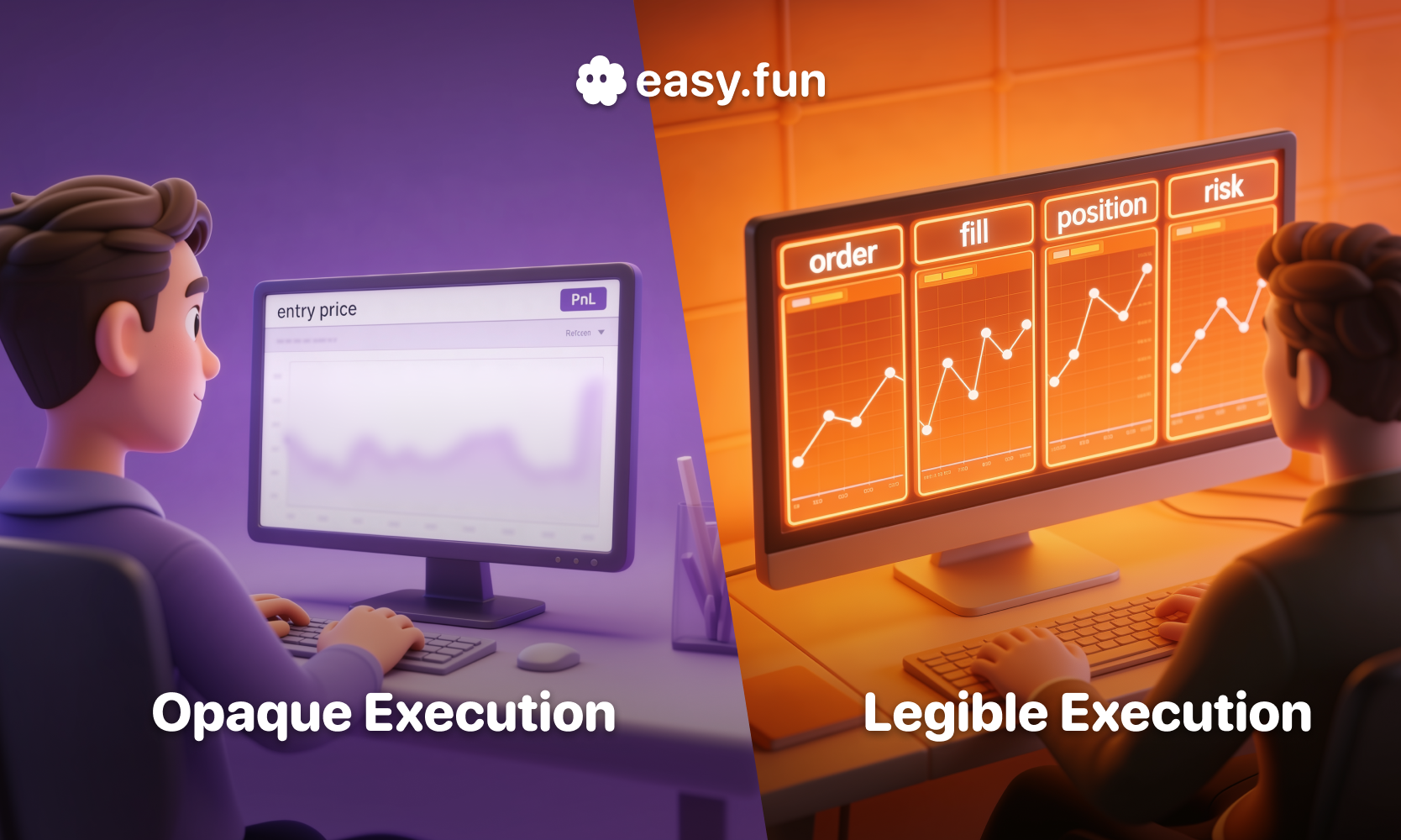
On a traditional platform, they see an entry price and a PnL line.
On easy.fun, the experience is different.
They see how liquidity supported the entry.
They observe how other participants positioned themselves.
They track how the position evolves relative to the broader market.
The trade is no longer just a number.
It's part of a system they can observe.
From Execution Engines to Observable Systems
Trading platforms have historically been execution engines.
We believe they are becoming observable systems.
As onchain infrastructure matures, the expectation will shift. Traders won't just want fast execution—they will expect to understand it.
easy.fun is moving in that direction.
By making the lifecycle of trades visible, we create a foundation for deeper participation. Traders can learn not just from outcomes, but from process.
As the arena evolves, these systems will become even more expressive. More structured comparisons. More visible dynamics. More ways to understand how trades interact with markets in real time.
This is especially important as competitive layers begin to form.
When execution is transparent, competition becomes meaningful.
When settlement is visible, performance becomes verifiable.
The future of trading isn't just faster.
It's clearer.
Every trade tells a story. Most platforms only show the ending.
- Explore easy.fun - See how trades unfold in real time.
- Join our Discord - Learn from traders observing the same system.
- Follow us on X - Stay updated as the arena evolves.