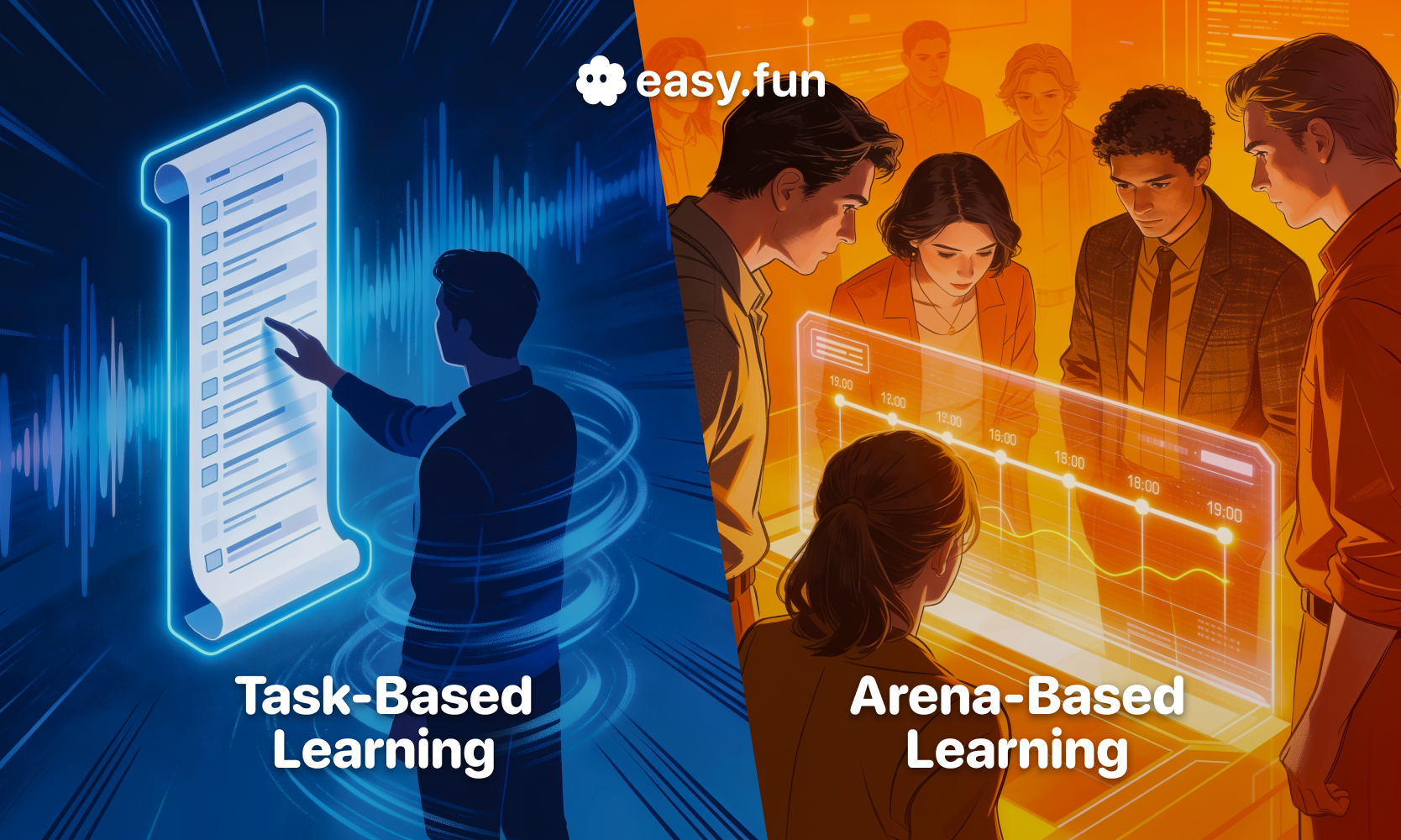
Most trading platforms frame trading as a task. Open a chart. Place an order. Close a position. Repeat.
This framing appears neutral and professional. But it hides a deeper problem: tasks are meant to be completed, not lived in. When trading is reduced to a checklist of actions, learning becomes slow, engagement fades, and mistakes feel personal rather than instructive. Every loss feels like a failure of judgment. Every win feels temporary and isolated.
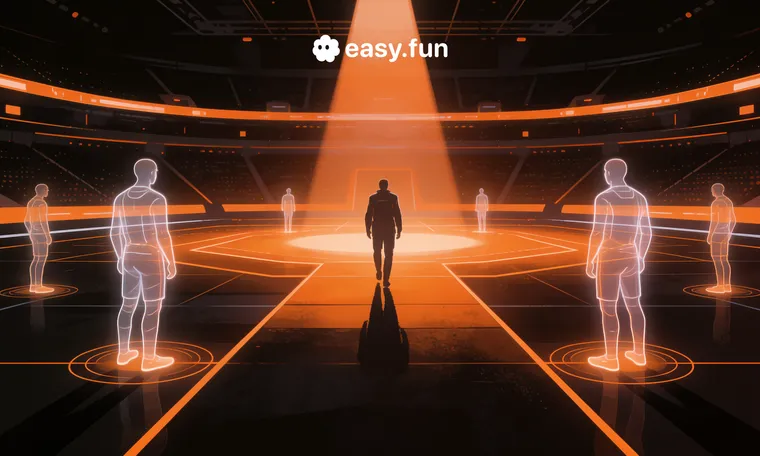
Now compare that to how people learn anything difficult at scale: sports, games, competitive programming, even content creation. These domains don't treat improvement as a private struggle. They create arenas. Clear rules. Visible performance. Shared context. You don't just do the activity, you enter it.
At easy.fun, we believe trading belongs in that second category. Not as entertainment, and not as spectacle, but as a competitive skill that benefits from structure, comparison, and shared momentum. That belief shapes everything we build.
Why the Current Trading Model Breaks Learning and Motivation
The modern trading stack is optimized for execution speed and capital efficiency. That's important. But culturally, it leaves traders alone.
Most platforms assume the user already knows how to trade. Education is externalized to YouTube, Twitter threads, Discord groups, or paid courses. Performance is private. Context is fragmented. Feedback is delayed or distorted by hindsight bias.
For new traders, this creates paralysis. There's too much information, no clear benchmark, and no sense of progress beyond account balance. For experienced traders, the problem flips. They operate in isolation, with no structured way to test ideas socially or to build a durable reputation beyond self-reported results.
Even social trading tools often miss the point. They turn traders into signals and followers into copy machines. There's no shared narrative, no real-time tension, and no identity beyond "profitable or not".
The result is a culture where:
- Losses feel shameful rather than instructive
- Wins don't compound into status or trust
- Most participants churn quietly
This isn't a market problem. It's a framing problem.
Why Competition Is a Learning Primitive
At easy.fun, we don't see trading as a sequence of actions.
We see it as a competitive environment where skills emerge through comparison, repetition, and feedback.
Competition doesn't mean aggression. It means context.
In an arena, performance is visible. Not to shame, but to orient. You know where you stand, who you're learning from, and what "better" looks like. Losses are no longer private failures; they're part of a shared landscape where everyone sees the same conditions.
This is how humans have learned complex skills for centuries. Martial arts, chess, esports, athletics. None of them relies on isolated practice alone. They rely on arenas.
easy.fun is built around that idea:
- Traders operate in real time, onchain, with visible execution
- Followers don't just consume outcomes; they experience the process
- Reputation forms through sustained behavior, not single screenshots
By shifting from a task frame to an arena frame, we change how users relate to risk. Risk becomes something to manage collectively, learn from publicly, and contextualize within a broader performance arc.
That's how passive followers become active participants.
Not by forcing engagement, but by giving them a place where engagement makes sense.
Mechanisms, Behaviors, and Real Signals
An arena is not a metaphor. It's a system design choice.
Shared Time, Not Asynchronous Claims
In most trading communities, performance is reported after the fact. This rewards storytelling, not skill. The arena mindset demands simultaneity. Actions, reactions, and outcomes happen in the same temporal frame.
On easy.fun, trades unfold live. Followers see entries, exits, and position changes as they happen. This creates tension, focus, and accountability — the same ingredients that make competitive environments effective teachers.
Identity Through Behavior, Not Branding
In an arena, identity is earned. Not declared.
Traders build reputations through consistency: how they size risk, how they behave under drawdown, how they adapt. Followers learn not just what a trader does, but how they think.
This shifts attention away from one-off wins and toward long-term performance patterns. Over time, traders stop optimizing for screenshots and start optimizing for trust.
Participation Without Prediction
Most people hesitate to trade because prediction feels intimidating. Arenas don't require prediction upfront. They allow participation through observation, alignment, and gradual involvement.
easy.fun lets users enter the arena by following strategies, observing execution, and learning through proximity. Action comes naturally once context is established.
This mirrors how spectators become players in every competitive domain.
Feedback Loops That Encourage Return
Games retain players because feedback is immediate and meaningful. The arena mindset applies the same principle.
Every trade updates the context. Every session adds to memory. Users don't ask "Did I win today?" They ask, "Did I improve?"
That question is the foundation of long-term engagement.
Looking Ahead: Building the Onchain Arena
Our long-term vision is not to gamify trading.
It's to normalize the idea that trading is a public, learnable, competitive skill.
We see easy.fun evolving into a home base where:
- Traders develop careers, not just PnL curves
- Followers grow into confident participants
- Onchain markets feel alive, not abstract
As the ecosystem grows, the arena becomes richer. More context. More structure. More ways to measure improvement beyond profit alone.
This is how trading stops being a solitary grind and starts becoming a shared pursuit.
If trading feels lonely, opaque, or unnecessarily hard, you're not alone.
Trading is a skill. The arena is open.
Enter the arena!
- Explore easy.fun - Experience trading in a competitive, social frame.
- Join our Discord - Meet others learning inside the arena.
- Follow us on X - Stay close as we continue building.