Every generation invents new arenas.
A century ago, it was stadiums. Tens of thousands gathered to watch athletes push physical limits in public contests of strength and endurance. Decades later, television turned sports into a global spectacle. Then came esports, where players competed inside digital environments while millions watched online, understanding every move because they knew the game themselves.
What these arenas share is simple: visible skill under pressure. The drama doesn't come from randomness—it comes from the human mind navigating complex systems in real time.
Trading has always contained those same ingredients: competition, uncertainty, psychological tension, and strategic decision-making. Yet historically, it happened behind closed terminals, invisible to everyone except the participants.
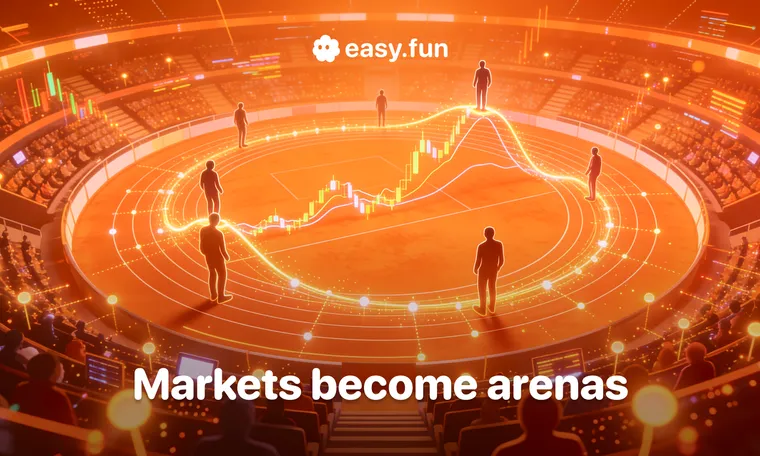
That is beginning to change. As markets move onchain and platforms like easy.fun make participation visible in real time, trading is starting to look less like a solitary financial activity—and more like the next global competitive sport.
Why Trading Has Never Felt Like a Shared Competition
For decades, trading infrastructure prioritized execution efficiency over social visibility. Orders were private. Positions were hidden. Strategies lived in individual terminals.
Even when markets became digital, they never became communal.
Centralized exchanges turned trading into a fast but silent activity. You could see prices and liquidity, but not the behavior behind them. Decisions were opaque. Performance existed only as private PnL.
At the same time, social media created a parallel universe around trading. Traders posted screenshots, narratives, and opinions—but rarely verifiable context. Followers watched outcomes without understanding the decisions that produced them.
The result was a strange split:
- Markets were global
- Participation was individual
- Observation happened through unreliable storytelling
This environment made trading feel less like a competitive discipline and more like speculation performed in isolation.
And without a shared arena, the most compelling element of competition—watching skill unfold under identical conditions—was missing entirely.
Trading Becomes a Sport When the Arena Is Visible
Sports, games, and esports all rely on the same structural principle: everyone plays under the same rules, in the same environment, at the same time.
That's what makes competition meaningful.
We believe trading has always been competitive in essence—but lacked the infrastructure to make that competition visible.
The rise of onchain markets changes that.
With transparent execution and real-time data, trading can now move from a private activity to a shared environment. When traders operate within the same observable conditions, decisions become legible. Skill becomes comparable. Participation becomes social.
At easy.fun, we treat trading not as a solitary interface but as an arena.
An arena is not merely a leaderboard. It's an environment where:
- actions happen in real time
- performance is verifiable
- participants share the same informational ground
This structure transforms the experience.
Instead of passively watching price charts, users observe strategies unfold live. Instead of trusting narratives, they see execution directly. Instead of following personalities, they evaluate behavior.
The shift is subtle but profound.
Markets stop feeling like abstract systems and start feeling like competitive environments.
In that sense, trading begins to resemble esports: a complex system where decision-making speed, risk control, and psychological discipline determine outcomes.

How Arena Trading Creates Spectacle
Real-Time Visibility Turns Strategy Into Narrative
In traditional trading, most strategies remain invisible until after the fact.
In an arena environment, the story unfolds live. Entries, adjustments, and exits occur in front of participants observing the same market context. This creates narrative naturally—without commentary.
A trader navigating volatility becomes a visible strategic actor, much like a player maneuvering through a match.
Shared Market Conditions Create Fair Competition
In sports, fairness comes from shared rules and identical conditions. Arena-style trading introduces a similar dynamic.
All traders operate within the same liquidity environment, price movements, and timing constraints. The difference lies not in privileged information but in interpretation and discipline.
This alignment allows spectators and participants alike to evaluate decisions meaningfully.
Psychological Tension Drives Engagement
The appeal of watching competitive activity comes from uncertainty combined with skill.
Trading amplifies this dynamic. Markets evolve continuously, forcing traders to manage risk, adapt strategies, and respond to new signals under time pressure.
When these decisions are observable, the emotional arc resembles competition:
anticipation → reaction → resolution.
This feedback loop is what makes competitive systems compelling to watch and participate in.
Spectators Become Participants
Perhaps the most important transformation is how observation converts into participation.
In esports, viewers often become players. The barrier between spectator and competitor is fluid.
Arena-style trading operates similarly. When users watch strategies unfold in real time, they begin to internalize patterns. The distance between observing and acting shrinks.
Instead of consuming trading content passively, users develop intuition by seeing how decisions evolve under live market conditions.
This is where education becomes experiential rather than theoretical.
Emerging Competitive Structures
As participation grows, arenas naturally evolve toward more structured forms of competition.
Clear benchmarks, session-based comparisons, and transparent metrics allow traders to evaluate themselves against peers in increasingly meaningful ways.
The goal is not spectacle alone, but legibility of skill.
Over time, these structures will continue to develop, bringing clearer formats for comparison while preserving the openness and transparency that define onchain markets.
Trading as the First Truly Global Mind Sport
Physical sports are limited by geography. Esports are limited by game publishers.
Onchain trading may become the first competitive environment that is simultaneously global, open, and continuously evolving.
Anyone with internet access can participate. Markets never fully close. Conditions change every second.
This creates a unique form of competition: a real-time strategic contest played on the largest financial networks in the world.
As platforms like easy.fun continue to structure these environments into clearer arenas, new cultural dynamics emerge.
Traders begin to identify themselves not just by profit, but by style and discipline. Communities form around strategies rather than personalities. Spectators develop literacy in market behavior much like sports fans learn the nuances of a game.
Over time, trading could become one of the most accessible competitive systems ever created—part sport, part strategy game, part economic participation.
And unlike traditional sports, the arena is not built once and maintained. It evolves alongside the market itself.
The next generation of competition may not happen in stadiums or game servers. It may happen in markets.
The arena is open!
- Explore easy.fun - Discover the arena and experience trading in real time.
- Join our Discord - Meet traders and observers learning together.
- Follow us on X - Stay close as the arena continues to evolve.