Crypto trading has always loved the myth of the lone genius. The trader who sees what no one else sees. The one who fades consensus, clicks faster, thinks sharper, and walks away with the win. We amplify these stories because they're clean, dramatic, and easy to tell.
But anyone who has actually traded through volatility knows a quieter truth. Real performance is rarely solitary. Ideas are tested in group chats. Risk is shaped by shared sentiment. Conviction forms when multiple signals align at once. Even the best traders don't operate in isolation—they operate in context.
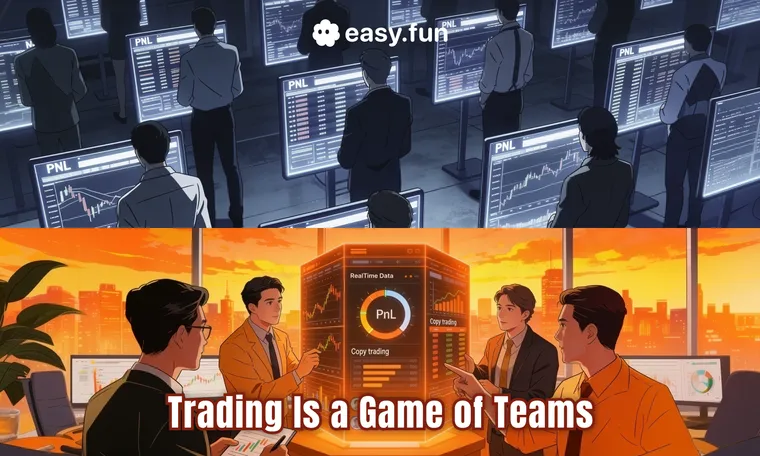
Markets are collective systems. And in every mature competitive environment—from sports to esports to open-source—long-term advantage moves away from individual brilliance and toward coordination. Trading is reaching that moment now.
Why the Lone-Trader Model Is Breaking
The modern trading stack was never designed for teams.
Centralized exchanges reduce traders to isolated accounts. You see your own positions, your own PnL, your own mistakes. Everyone else might as well not exist. There is no native way to share process, distribute trust, or compound insight across people.
Decentralized trading fixed custody and transparency, but not collaboration. Wallets are public, yet context is missing. You can see what happened, but not why. You can copy a transaction, but not the reasoning, timing, or risk framework behind it. Learning becomes imitation without understanding.
Social platforms sit on top of trading, not inside it. Twitter rewards confidence over correctness. YouTube rewards hindsight. TikTok rewards certainty. The incentives push traders to perform for attention, not execute with discipline.
For newcomers, this creates confusion and paralysis. For experienced traders, it creates fragility—one bad stretch and credibility evaporates. Trust resets every cycle.
Solo trading might produce moments of brilliance. But it doesn't scale trust. And without trust, performance can't compound.
Markets Reward Coordination, Not Isolation
We believe trading is a competitive skill—and skills develop faster in shared environments.
At easy.fun, our core belief is simple: markets reward coordination over time. Not because individuals don’t matter, but because collective clarity outperforms isolated decision-making.
Built on Hyperliquid, easy.fun starts with what matters most: deep liquidity, fast execution, and fully onchain transparency. That’s the foundation. But infrastructure alone doesn’t create edge. Culture does.
We design easy.fun as an arena, not a terminal. An environment where decisions are visible, outcomes are verifiable, and reputation is earned through repeated action—not claims.
This is how passive followers become active participants. When users can watch trades unfold live, understand the context behind them, and choose to participate through copy trading or discussion, learning accelerates. Trust becomes measurable. Skill becomes legible.
We're not trying to eliminate individual responsibility. Every trader still owns their risk. But no one should have to trade blind, disconnected from the collective intelligence of the market.
How Teams Form on easy.fun
Live Onchain Trading as Shared Reality
Every trade on easy.fun is powered by Hyperliquid and visible in real time. Entries, exits, positions, and PnL update live. This creates a shared game state—everyone sees the same market conditions as they evolve.
When volatility hits, teams react faster because context is already aligned.
Copy Trading as Delegated Trust
Copy trading on easy.fun isn't blind mimicry. It's transparent delegation. Users choose traders based on verified onchain performance, historical drawdowns, and consistency. Allocation is flexible. Control always stays with the follower.
Over time, this creates natural team structures: lead traders and their communities. Performance becomes collective. When the leader improves, the group benefits.
Live Chat for Decision-Making in Motion
Markets don't pause for post-mortems. Our live chat runs alongside live trades, allowing traders to explain intent, react to changing conditions, and engage with followers in the moment.
This is where coordination happens—not after the trade, but during it.
Public Profiles as Onchain Track Records
Each trader builds a public profile showing PnL, win rates, drawdowns, and activity cadence. These profiles act as living résumés—portable, verifiable, and earned entirely onchain.
Competitive formats such as trading PK tournaments are actively in development and will be introduced in future phases.
Together, these mechanisms turn trading from a solitary action into a coordinated system.
From Teams to Onchain Leagues
We see a future where trading looks less like isolated accounts and more like organized competition.
Teams will form around strategies. Strategies will develop reputations. Reputation will unlock distribution, collaboration, and opportunity. Capital will follow coordination.
As the arena evolves, we envision seasons instead of moments, sustained performance instead of viral trades, and communities built around execution—not speculation.
Onchain infrastructure finally gives us the rails to support this kind of system. easy.fun is building the social layer that makes it possible.
Trading isn't a solo game anymore. Find your team.
Trade as a team!
- Explore easy.fun - Discover the app and start your trading journey.
- Join our Discord - Meet the community and share insights.
- Follow us on X - Stay updated with new features and top traders.