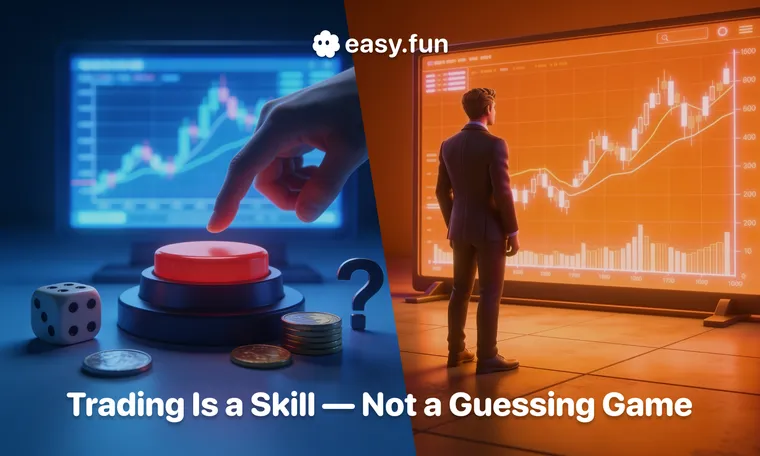
Most people don't fail at trading because they lack intelligence. They fail because they're asked to learn a skill in the worst possible environment.
Imagine learning basketball by reading playbooks alone. Or learning music by watching concert highlights without ever touching an instrument. That's what most trading platforms implicitly demand. They drop users into live markets, surround them with charts and indicators, and expect competence to emerge from exposure.
When traders lose, the common explanation is "bad discipline" or "bad psychology". But underneath that is a deeper issue: trading is framed as a guessing game. You predict. You're right or wrong. You move on. There's no shared context, no visible progression, no structured feedback loop.
At easy.fun, we see trading differently. Trading is a skill — learned through repetition, comparison, and real-time feedback. And like any serious skill, it needs an arena. A place where learning happens while doing, not after the fact.
The Guessing Game Trap: Why Most Traders Never Actually Learn
The dominant trading experience today encourages prediction over practice.
Users are told to "find an edge", "read the market", or "time entries perfectly". Education lives outside the platform — in YouTube videos, Twitter threads, Discord chats, or paid courses. Execution happens alone. Reflection, if it happens at all, is private and delayed.
This creates several compounding problems.
First, learning is abstract. Traders consume theory in isolation, then attempt to apply it under real financial pressure. There's no safe gradient from observation to participation. You either trade, or you don't.
Second, feedback is distorted. Wins are often random. Losses feel personal. Without comparison or shared benchmarks, it's impossible to tell whether an outcome reflects skill, variance, or pure luck.
Third, the social layer is broken. Trading communities talk about markets, but rarely trade together. Performance is selectively shared. Context is missing. Trust is fragile.
Over time, traders internalize the wrong lesson: that success comes from better guessing. More indicators. Faster reactions. Louder conviction.
But guessing is not a skill. And markets are not classrooms by default.
Skills Are Forged in Arenas: Why Live Context Changes Everything
A skill is not knowledge. A skill is behavior, expressed repeatedly under constraint.
At easy.fun, we start from a simple premise: if trading is a skill, then learning must happen where trading actually occurs — in real time, with real stakes, and with other people present.
That's what the arena model provides.
An arena creates shared context. Everyone sees the same market, at the same moment, reacting to the same signals. Decisions are no longer abstract or hypothetical. They're anchored in time.
It also creates comparison — not in a judgmental sense, but in a directional one. You learn faster when you can observe how others respond to the same situation. You notice what you missed. You internalize pacing, risk tolerance, and discipline.
Most importantly, arenas turn learning into participation. You don't need to predict perfectly to belong. You can enter by observing, aligning, and gradually acting. Over time, confidence builds naturally because it's grounded in lived experience, not theory.
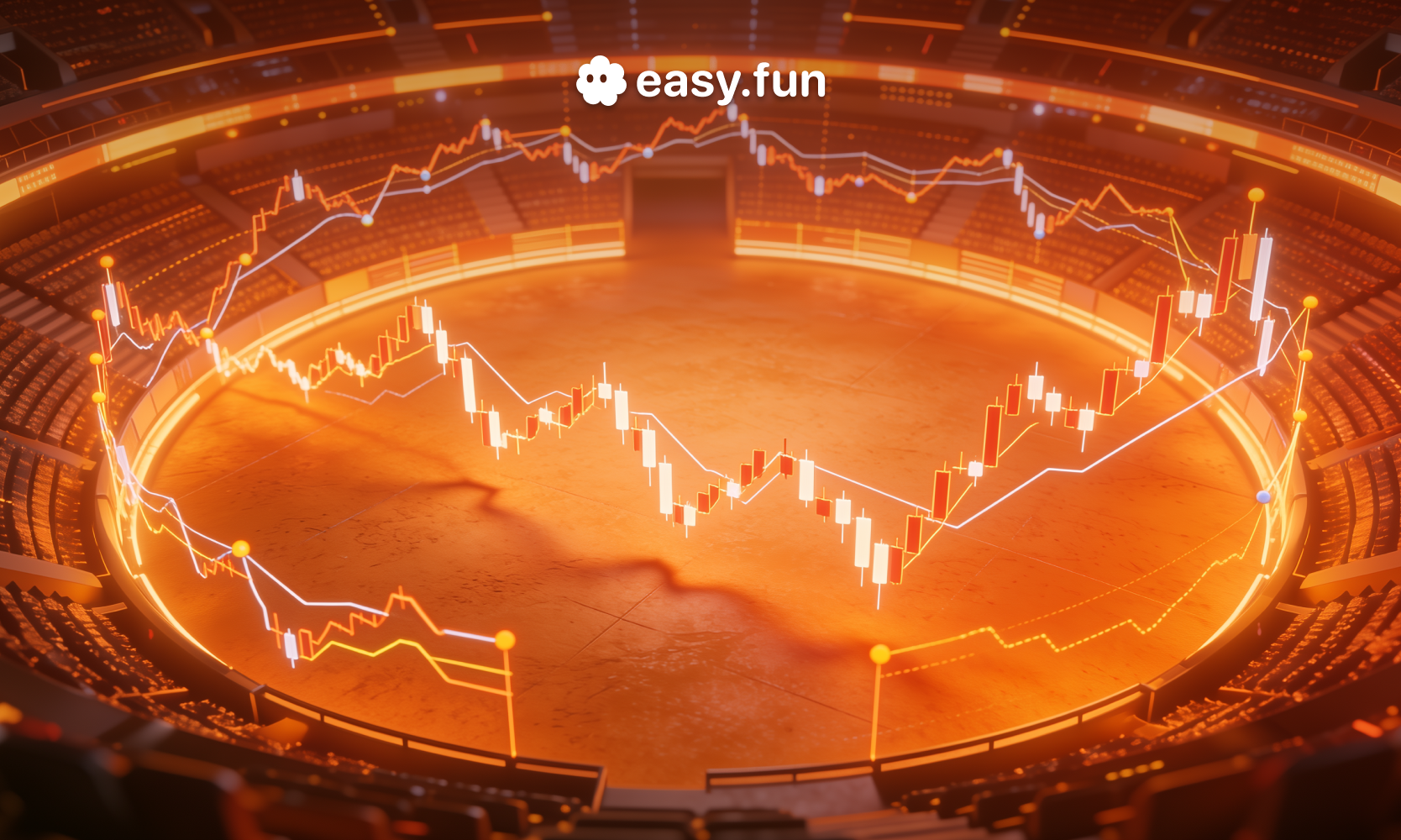
easy.fun is built to support this shift:
- from hindsight analysis to live execution
- from isolated decisions to shared timelines
- from passive following to active involvement
We don't teach trading as a set of rules. We create an environment where rules reveal themselves through practice.
How the Arena Turns Learning into Practice
The arena model works because it aligns human learning with system design.
Learning Happens in the Moment
Most educational content explains what should have been done. Arenas show what is being done. This difference matters.
On easy.fun, trades unfold live. Followers experience entries, exits, and adjustments as they happen. There's no editing, no narrative polish, no selective memory. Learning becomes situational rather than theoretical.
This is how instincts form.
Observation Without Pressure
In an arena, not everyone needs to act immediately. Observation is a valid form of participation.
Users can follow traders, watch behavior under stress, and understand how decisions evolve across market conditions. Over time, patterns emerge. Confidence grows. Action feels earned rather than forced.
This mirrors how apprentices learn crafts and how players learn games — by proximity before mastery.
Feedback Is Immediate and Honest
Every trade produces feedback. Not just PnL, but timing, volatility response, and emotional control. Because everything happens in shared time, feedback isn't delayed or distorted.
Losses don't feel like failures. They feel like data.
This reframes risk. Instead of something to avoid, risk becomes something to understand.
Identity Forms Through Consistency
In guessing cultures, reputation is fragile. In arenas, it's cumulative.
Traders build identity through repeated behavior. Followers recognize style, not just results. Trust forms slowly, but it lasts.
This encourages discipline over bravado — exactly what long-term trading demands.
Quiet Signals of What's Coming Next
As participation deepens, arenas naturally evolve toward structured competition. Not spectacle, but measured comparison. Not hype, but clarity.
When learning is already live and shared, adding new layers becomes a matter of refinement, not disruption.
From Guessing to Mastery
We believe trading should feel learnable.
The future we're building toward is one where:
- traders grow through visible practice
- newcomers enter without intimidation
- markets feel like environments, not puzzles
easy.fun is becoming a place where trading lives — not just where it executes. A home base for people who want to improve, together, in public, over time.
Because when learning is continuous and contextual, skill compounds. And when skill compounds, guessing fades away.
If trading has felt random, lonely, or unnecessarily hard, it's not your fault. The environment matters.
Trading is a skill. The arena is where it's learned.
Enter the arena!
- Explore easy.fun - Experience trading as live practice.
- Join our Discord - Learn alongside others inside the arena.
- Follow us on X - Stay close as we continue building.