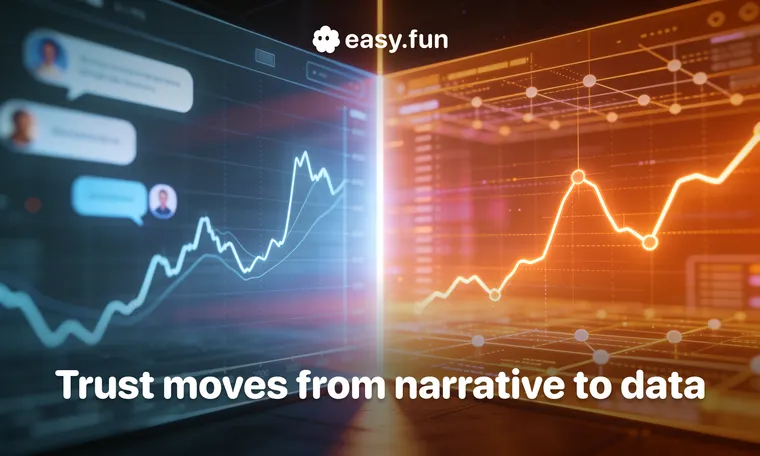
Most traders don't lose money because they lack information. They lose because they trust the wrong information.
In modern markets, performance is everywhere. Screenshots. Threads. Leaderboards. Signals. The problem isn't access—it's verification. You can see outcomes, but not the process behind them. You can follow strategies, but not the conditions under which they were executed.
This creates a strange dynamic. Traders spend more time evaluating people than evaluating systems. Trust becomes social rather than structural. And once trust becomes narrative-driven, it becomes fragile.
Onchain trading offers a different path.
When execution, positions, and outcomes are recorded transparently—and updated in real time—performance stops being a claim. It becomes something you can observe directly. That shift doesn't just improve trust. It changes how traders think, how they learn, and ultimately how they act.
The Trust Gap in Trading Performance
Why Most Performance Signals Are Unreliable
In traditional and even many crypto-native environments, performance is filtered.
Traders highlight winning trades. Strategies are presented after success. Losses are minimized or omitted. Even when data is shared, it often lacks context: position size, timing, exposure, and risk are rarely fully visible.
This leads to a structural trust problem.
- Followers can't verify consistency
- Traders can't benchmark meaningfully
- Learning becomes dependent on interpretation rather than observation
Over time, this erodes confidence—not just in individuals, but in the idea that trading skills can be understood at all.
The Limits of Centralized Transparency
Centralized platforms improve execution but don't solve visibility.
Internal matching engines, hidden order flows, and opaque risk systems mean that even accurate performance data is difficult to audit. Users must trust the platform's representation of reality.
Even analytics tools, while useful, are often delayed or abstracted. By the time data is processed and presented, the context that made it meaningful has already passed.
The result is a fragmented system:
- Decisions happen in real time
- Data is interpreted after the fact
- Trust sits somewhere in between
This disconnect prevents traders from building reliable mental models.
Transparency Is the Real Edge
Alpha Is Not Information. It's Clarity
We don't think the next generation of trading advantage comes from more signals.
It comes from clearer signals.
Hyperliquid changes the foundation by making execution onchain, fast, and verifiable. Orders, fills, positions, and settlements exist on a shared layer. This removes the gap between action and record.
easy.fun builds on top of this by making that data legible in real time.
Instead of asking traders to interpret raw onchain data, we present it as a structured context:
- who is active
- how capital is deployed
- how positions evolve under live conditions
This turns transparency into something actionable.
From Trusting People to Trusting Systems
When performance is visible and verifiable, trust shifts.
You don't need to believe someone's claim—you can observe their behavior.
You don't need to rely on curated narratives—you can see how strategies perform across sessions.
This changes the role of the trader.
Instead of being a source of signals, they become a source of observable processes. Instead of building an audience, they build a track record.
Participation Changes When Trust Is Structural
For beginners, this reduces uncertainty.
Instead of asking "Who should I follow?"
They can ask, "What is actually happening?"
For experienced traders, it sharpens discipline.
When behavior is visible, inconsistency becomes obvious. Risk becomes measurable. Performance becomes harder to fake.
This is how passive followers become active participants.
Not by adding features—but by removing ambiguity.
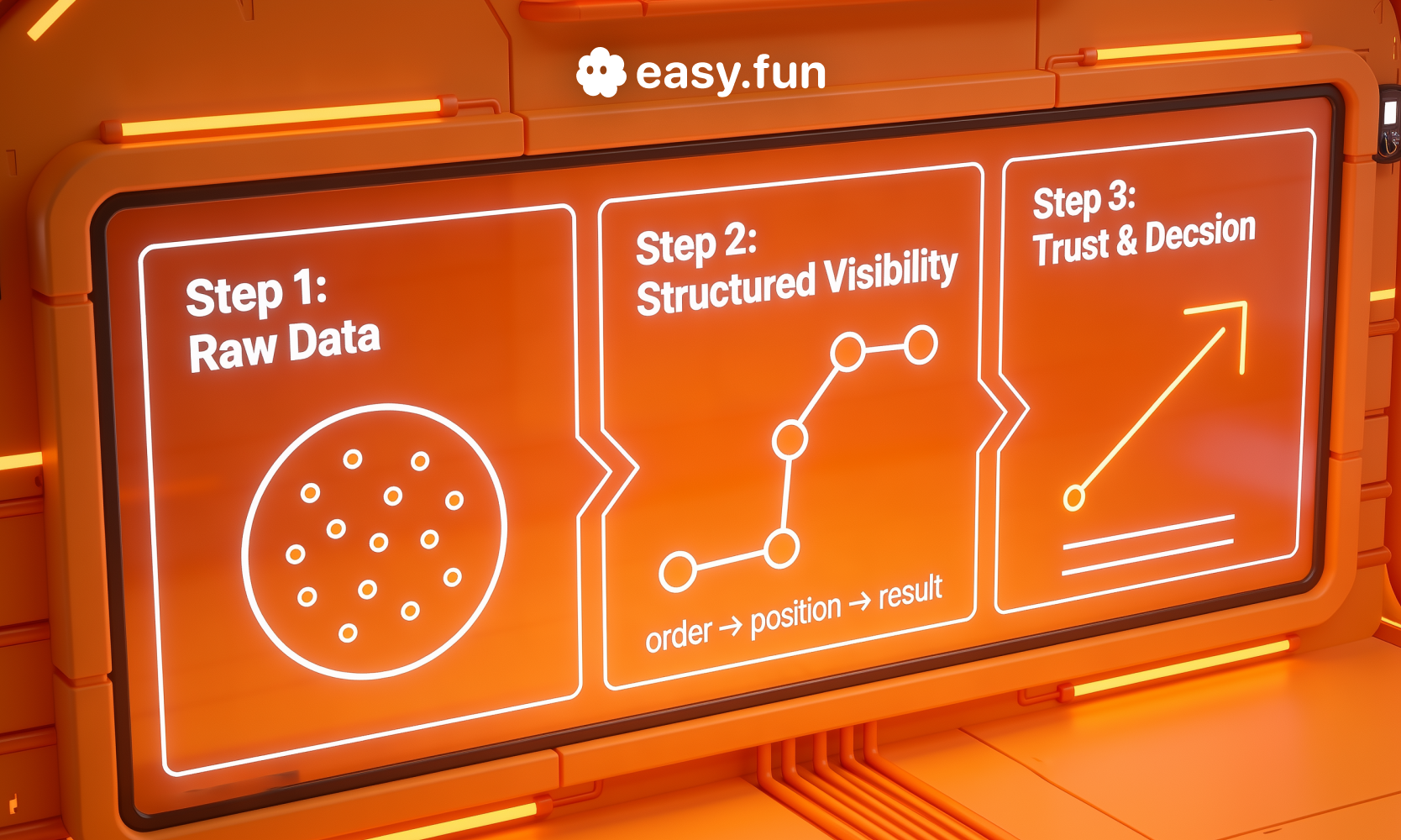
How Onchain Transparency Works in Practice
Real-Time Data, Not Delayed Narratives
In traditional systems, performance is often reconstructed.
On easy.fun, it is observed.
Because Hyperliquid operates in real time onchain, execution data is immediately available. Traders see positions as they form, not after they're summarized.
This eliminates hindsight bias.
A strategy is no longer judged by how it looks after success—but by how it behaves in motion.
Full Context, Not Isolated Metrics
PnL alone is incomplete.
A profitable trade with high risk tells a different story than one achieved with controlled exposure. By combining metrics—position size, duration, drawdown, and timing—easy.fun provides a fuller picture.
This allows traders to evaluate:
- consistency
- discipline
- adaptability
instead of just outcomes.
Shared Visibility Creates Collective Intelligence
When all participants operate within the same observable system, learning becomes distributed.
Traders compare decisions made under identical conditions. Patterns emerge naturally. Strong behaviors repeat. Weak behaviors fade.
This is not imitation—it's alignment.
Over time, the market becomes easier to interpret because its participants are easier to understand.
Transparency Reduces Noise
In narrative-driven environments, noise dominates.
Onchain transparency filters this.
If a strategy is inconsistent, it becomes visible.
If performance depends on selective reporting, it becomes irrelevant.
Attention shifts from storytelling to execution.
This reduces cognitive overload for participants and improves signal quality across the ecosystem.
Case: Two Traders, One Market
Two traders claim the same strategy.
In a traditional environment, both appear credible.
In a transparent system:
- one shows consistent sizing and disciplined exits
- the other shows irregular exposure and reactive decisions
The difference is no longer subjective.
It's structural.
This is what makes transparency powerful—not because it predicts success, but because it reveals behavior.
The Early Shape of Verifiable Competition
As transparency becomes standard, comparison becomes meaningful.
Traders begin to measure themselves against verifiable benchmarks. Not just who is profitable—but who is consistent, controlled, and adaptive.
Over time, these comparisons naturally evolve into clearer competitive structures.
Not artificial gamification, but structured visibility.
The arena becomes not just a place to trade—but a place to measure.
Transparency as the Default Layer
We believe that in the long run, transparency will not be a feature. It will be an expectation.
Markets will move toward systems where:
- execution is visible
- performance is verifiable
- strategies are understood through behavior
In this environment, trust no longer depends on reputation alone. It emerges from observable reality.
easy.fun is part of that transition.
By making onchain data accessible, legible, and shared, we are building a foundation where traders can operate with clarity rather than assumption.
As the ecosystem evolves, this transparency will support more structured forms of comparison—where skill is not just demonstrated, but measured in context.
The end state is not perfect information. It is trustworthy information.
And that difference is what enables real progress.
See what's real.
In trading, trust is often assumed. Onchain, it can be verified.
- Explore easy.fun - Experience trading with real-time, transparent data.
- Join our Discord - Learn from traders operating in the same visible system.
- Follow us on X - Stay updated as the arena continues to evolve.