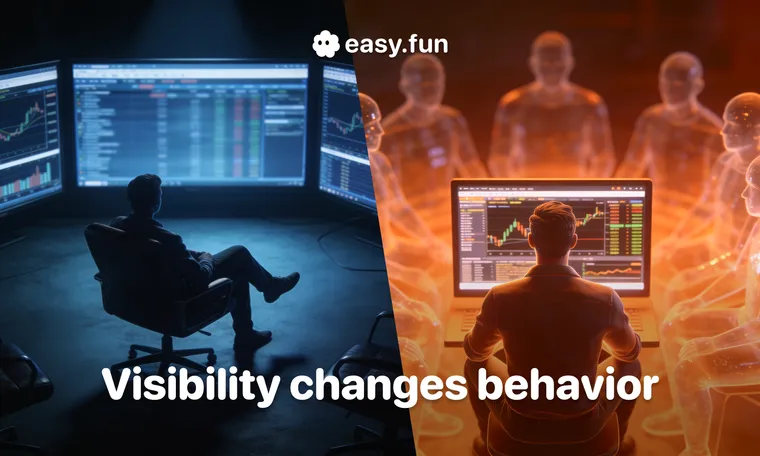
Trading feels different when no one is watching.
Mistakes are easier to ignore. Risk is easier to justify. Losses can be reframed as bad luck instead of poor decisions. In isolation, traders operate inside their own narratives. Wins reinforce confidence. Losses are explained away. Improvement is inconsistent, because feedback is incomplete.
Now change one variable: make performance visible.
Not as a screenshot. Not as a curated result. But as a real-time process, unfolding in front of others operating under the same conditions.
The psychological shift is immediate.
Decisions slow down. Risk feels heavier. Discipline becomes more than a personal preference—it becomes something others can observe. The same trade that felt easy in private suddenly carries weight.
This is what happens inside an arena.
And once you've traded inside one, it's hard to go back.
Why Private Trading Distorts Behavior
Isolation Creates Narrative, Not Discipline
Most trading environments are private by default.
You execute trades alone. You review outcomes alone. You decide what to remember and what to ignore. This creates a subtle but powerful distortion: traders begin optimizing for internal comfort rather than external consistency.
Without shared visibility, behavior becomes flexible in the wrong way.
- Risk expands after wins
- Losses linger without structure
- Strategies shift without accountability
Because no one sees the full process, there's no pressure to maintain coherence.
Social Layers Don't Fix the Problem
At first glance, social trading platforms appear to solve this. They introduce followers, content, and engagement.
But most of these systems operate on delayed or incomplete information.
Traders post results, not process.
Audiences consume narratives, not execution.
Reputation is built on visibility, not verification.
This creates a different distortion: performance becomes performative.
Traders optimize for attention rather than consistency. Followers chase outcomes without understanding the decisions behind them.
The result is a system where both isolation and superficial visibility fail to produce real improvement.
Public Performance Changes Everything
Visibility Aligns Behavior With Reality
We believe that performance needs to be visible at the moment it's created, not reconstructed afterward.
When trading happens in a shared, real-time environment, behavior changes.
Traders become more deliberate.
Risk becomes intentional.
Consistency becomes necessary.
This is not because traders suddenly become more disciplined.
It's because the environment makes undisciplined behavior harder to sustain.
At easy.fun, we treat visibility as infrastructure.
By building on top of Hyperliquid's real-time, onchain execution layer, we ensure that actions and outcomes exist within a shared, verifiable context. Traders don't just report what they did—they operate inside a system where it can be observed.
Competition Without Spectacle
An arena doesn't need noise to be competitive.
In fact, the most effective competitive environments are quiet. The pressure comes not from external hype, but from internal awareness: others are operating under the same conditions, and your decisions exist alongside theirs.
This creates a subtle but powerful dynamic.
Traders stop focusing on individual wins.
They start focusing on repeatable behavior.
They think in sessions, not moments.
They act within frameworks, not impulses.
From Ego to Structure
In private trading, ego often drives decisions.
In an arena, ego is tested.
When performance is visible over time, inconsistency becomes obvious. Emotional trading stands out. Discipline compounds.
The environment shifts the question from:
"Was this trade right?"
to:
"Was this decision consistent with my process?"
That shift is what enables long-term improvement.
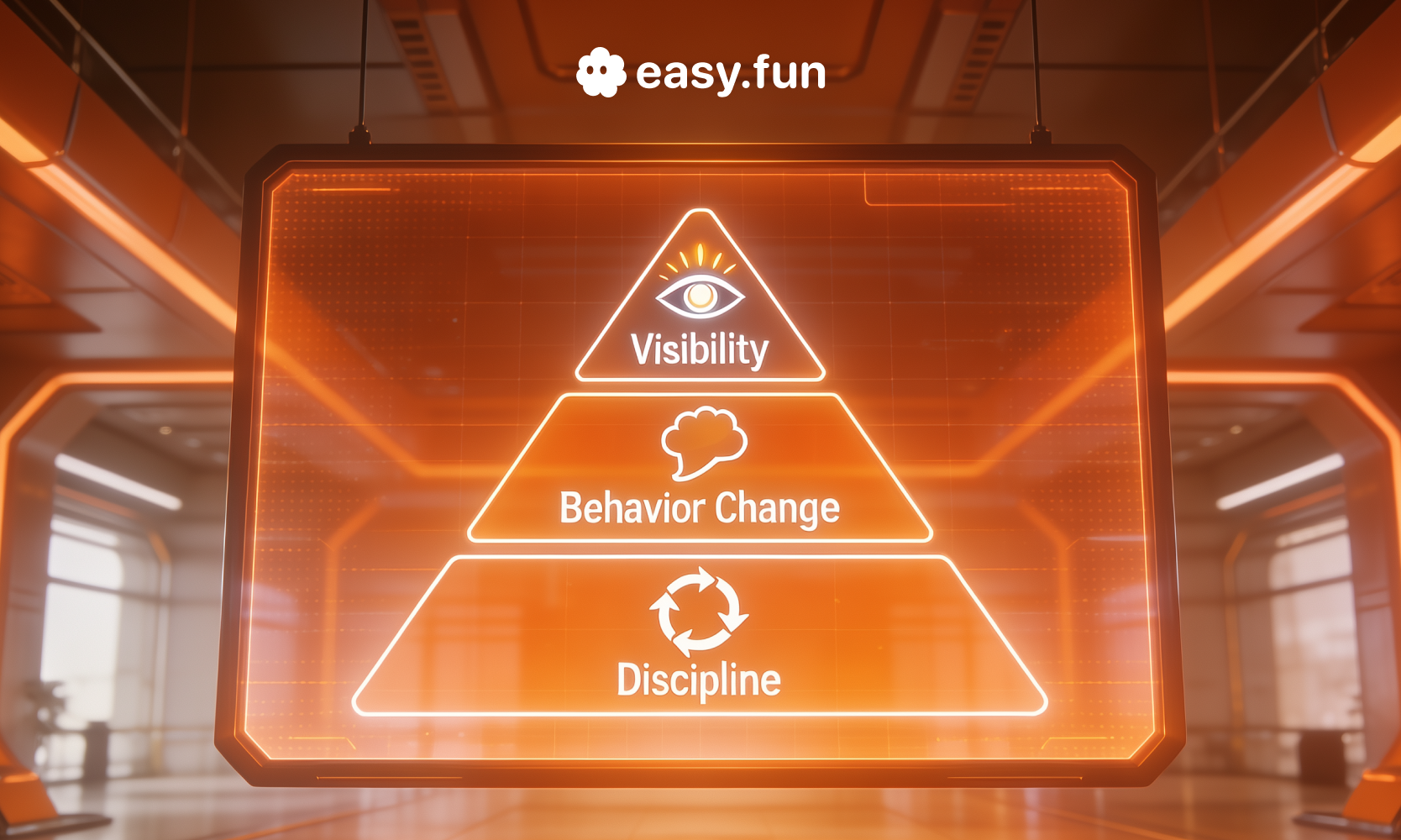
What Changes When Trading Becomes Public
Thinking: From Prediction to Process
In private environments, traders tend to focus on prediction.
Will the market go up or down?
Is this the right entry?
In an arena, prediction matters less than process.
Because decisions are visible, traders begin to evaluate themselves differently:
- Did I follow my risk framework?
- Did I size correctly?
- Did I react or execute?
Thinking becomes structured, not reactive.
Feeling: From Impulse to Awareness
Emotions don't disappear in public environments—but they change.
Fear becomes more noticeable.
Overconfidence becomes harder to hide.
Because actions are observable, traders become more aware of their own emotional states.
This awareness doesn't eliminate mistakes—but it reduces unconscious ones.
Acting: From Isolation to Alignment
Actions in an arena exist within a shared context.
Traders see how others behave under the same conditions. This doesn't mean copying—it means comparison.
Over time, alignment emerges:
- Risk becomes more consistent
- Timing improves through observation
- Strategies evolve through exposure
This is how skill compounds in competitive systems.
Case: The Same Trade, Two Environments
A trader enters a position during a volatile breakout.
In isolation:
They increase size mid-trade. They hesitate on exit. They rationalize the result afterward.
In an arena:
They define size before entry. They execute within structure. They review behavior in context.
The market is identical. The psychology is not.
Accountability Without Enforcement
One of the most important dynamics in arena trading is that accountability is not imposed—it emerges.
There are no forced rules, no external policing.
But visibility creates its own constraints.
When behavior is observable, inconsistency becomes self-evident.
This is a more sustainable form of discipline than external control.
The Early Shape of Competition
As more traders operate in shared environments, natural forms of competition begin to appear.
Not in the form of artificial rewards, but through comparison:
- consistency vs volatility
- discipline vs impulsiveness
- structure vs randomness
Over time, these comparisons become clearer, more structured, and more meaningful.
The arena doesn't create competition. It reveals it.
The Arena as a Psychological System
We often think of trading platforms as technical systems.
Execution speed. Latency. Liquidity.
But at scale, they are also psychological systems.
They shape how traders think, feel, and act.
Our long-term vision for easy.fun is to make this influence explicit.
By designing environments where behavior is visible, comparable, and grounded in real-time data, we create conditions where better habits emerge naturally.
As the arena evolves, competitive structures will become more defined—not as gamification, but as clarity.
Traders will understand where they stand.
They will measure themselves against meaningful benchmarks.
They will improve through participation, not abstraction.
In that world, winning is no longer about single outcomes.
It's about sustaining performance under visibility.
Whoever wins the arena, wins the game.
Trading reveals who you are. An arena makes it impossible to ignore.
- Explore easy.fun - Experience trading in a shared, real-time environment.
- Join our Discord - Learn alongside traders operating under the same conditions.
- Follow us on X - Stay updated as the arena continues to evolve.